Search This Blog

Showing posts with label Ebook. Show all posts

Tuesday, December 27, 2011

Oxford Handbook Of Clinical Surgery - 3rd Edition

Oxford Handbook of Clinical Surgery, 3rd Edition


This, the third edition of the Oxford Handbook of Clinical Surgery, reflects the changes which have occurred in general surgery over the seventeen years since the first edition was published.
Firstly, we have recruited the services of two new editors, a stark contrast to the original which was written by a single author with the assistance of a Surgical Registrar.
Secondly, each chapter has been written by a Specialist Consultant or Registrar in the subject and, therefore, presents a modern, state-of-the-art treatise on each topic.

Oxford Handbook of Clinical Specialties, 7th Edition

Oxford Handbook of Clinical Specialties, 7th Edition


Download Here

Oxford Handbook Of Clinical Specialties (7th Edition)

Oxford Handbook Of Clinical Medicine - 7th Edition

Oxford Handbook Of Clinical Medicine - 7th Edition


This book, written by junior doctors, is intended principally for medical students and house officers. The student becomes, imperceptibly, the house officer. For him we wrote this book not because we know so much, but because we know we remember so little. For the student the problem is not simply the quantity of information, but the diversity of places from which it is dispensed. Trailing eagerly behind the surgeon, the student is admonished never to forget alcohol withdrawal as a cause of post-operative confusion. The scrap of paper on which this is written spends a month in the white coat pocket before being lost for ever in the laundry. At different times, and in inconvenient places, a number of other causes may be presented to the student. Not only are these causes and aphorisms never brought together, but when, as a surgical house officer, the former student faces a confused patient, none is to hand.


Download Here

Wednesday, December 7, 2011

Oxford Handbook of Clinical Medicine, 6th Edition - Longmore, Murray; Wilkinson, Ian B; Rajagopalan, Supraj R

Oxford Handbook of Clinical Medicine, 6th Edition - Longmore, Murray; Wilkinson, Ian B; Rajagopalan, Supraj R 


This book, written by junior doctors, is intended principally for medical students and house officers. The student becomes, imperceptibly, the house officer. For him we wrote this book not because we know so much, but because we know we remember so little. For the student the problem is not simply the quantity of information, but the diversity of places from which it is dispensed. Trailing eagerly behind the surgeon, the student is admonished never to forget alcohol withdrawal as a cause of post-operative confusion. The scrap of paper on which this is written spends a month in the white coat pocket before being lost forever in the laundry. At different times, and in inconvenient places, a number of other causes may be presented to the student. Not only are these causes and aphorisms never brought together, but when, as a surgical house officer, the former student faces a confused patient, none is to hand.


Download Here

Oxford Handbook of Clinical Haematology, Second edition Drew Provan


Oxford Handbook of Clinical Haematology, Second edition - Drew Provan.

This small volume is intended to provide the essential core knowledge required to assess patients with possible disorders of the blood, organise relevant investigations and initiate therapy where necessary. By reducing extraneous information as much as possible, and presenting key information for each topic, a basic understanding of the pathophysiology is provided  and  this,  we  hope,  will  stimulate  readers  to  follow  this  up  by consulting the larger haematology textbooks.

Download Here

Oxford Handbook of Clinical Haematology, Second edition


Oxford Handbook of Clinical Examination and Practical Skills, 1st Edition - Thomas James, Monaghan Tanya


Oxford Handbook of Clinical Examination and Practical Skills, 1st Edition - Thomas James, Monaghan Tanya  

The first three chapters cover the basics of communication skills, history taking and general physical examination. Chapters 4,5,6,7,8,9,10,11,12,13 and 14 are divided by systems. In each of these there is a section on the common symptoms seen in that system, with the appropriate questions to ask the patient, details of how to examine parts of that system, and important patterns of disease presentation. Each of these system chapters is finished off with an ‘elderly patient’ page provided by Dr Richard Fuller. Following the systems, there are chapters on paediatric and psychiatric patients—something not found in many other books of this kind. The penultimate chapter—practical procedures—details all those tasks that junior doctors might be expected to perform. Finally, there is an extensive ‘data interpretation’ chapter which, whilst not exhaustive, tries to cover those topics such as ECG, ABG, and X-ray interpretation that may appear in a final ‘OSCE’ examination.

Download Here

Oxford Handbook Of Anaesthesia 2nd Edition

Oxford Handbook Of Anaesthesia 2nd Edition

Download Here


Oxford Handbook of Clinical and Laboratory Investigation - Drew Provan Andrew Krentz

Oxford Handbook of  Clinical and Laboratory  Investigation

By Drew Provan and Andrew Krentz


This book fills an obvious gap in the Handbook series and indeed a major lacuna in the medical literature. Too often investigations of a particular condition are lost in the welter of other text. Alternatively, they appear as specialist books in pathology and radiology. One unique feature of this book is the inclusion of all clinical investigative techniques, i.e. both truly clinical tests in the shape of symptoms and signs and then laboratory-based investigations. This stops what is often an artificial separation. Each section is clearly put together with the intent of easing rapid reference. This is essential if the book is to have (and I believe it does have) real use-fulness for bedside medicine. There are many other useful aspects of the text. These include a comprehensive list of abbreviations—the bugbear of medicine, as well as reference ranges which some laboratories still do not append to results. Overall, the Handbook should be of benefit to not just clinical students and junior doctors in training, but all who have patient contact. With this in one pocket, and Longmore in the other, there should be little excuse for errors in diagnosis and investigation, with the added
benefit that the balance between the two will allow the upright posture to be maintained.

Download Here

Oxford Handbook of Acute Medicine, 2nd Edition - Punit S Ramrakha and Kevin P Moore

Oxford Handbook of Acute Medicine, 2nd Edition

Punit S Ramrakha and Kevin P Moore.


Preface to the first edition
As every doctor soon discovers, the management of acute medical emergencies is the most demanding and stressful aspect of medical training. Most handbooks of clinical medicine can only go into general detail about the management of medical problems and the specific advice needed to manage acutely ill patients is usually insufficient in these texts.
The aim of this handbook is to give confidence to doctors to manage acute medical problems effectively and safely, and is intended to complement the Oxford Handbook of Clinical Medicine. Many books on acute medicine are written by senior staff, who have not been at the frontline for some time, and certain aspects of care are assumed or overlooked. This book was written by junior doctors with first-hand experience of the practical problems and dilemmas faced in casualty.
The layout of the book reflects clinical practice: assessment, differential diagnosis, immediate management, and some aspects of long-term therapy. We have included an extensive section on practical procedure as well as a section on pharmacotherapy to provide information on the use of certain common and unusual drugs to complement that provided the British National Formulary (BNF).
Throughout the book the text commonly exceeds that required for the management of specialist problems by the generalist. We make no apology for this. This is intended to provide the doctor with an understanding of specialist interventions so that they are more conversant with what is possible and what is happening to their patient.

Download Here


Tuesday, November 15, 2011

Oxford Handbook Of Accident and Emergency Medicine (2nd Edition)

Oxford Handbook Of Accident and Emergency Medicine (2nd Edition)


Editors: Wyatt, Jonathan P.; Illingworth, Robin N.; Clancy, Michael J.; Munro, Philip T.; Robertson, Colin E.

Download Here

Oxford Handbook Of Clinical Diagnosis (1st Edition)

Oxford Handbook Of Clinical Diagnosis (1st Edition)


This book explains how to use a history, examination and preliminary tests to arrive at a diagnosis in a transparent way. The diagnosis is a title for what we imagine is happening to a patient physically and socially. It allows us to anticipate what may happen next, how this can be influenced by intervention and to share with the patient and colleagues in various disciplines what we are doing.
The book allows the diagnostician to focus on symptoms, physical signs and initial test results that are likely to lead to a diagnosis. This is based on the principle that ‘diagnostic leads’ with short differential diagnoses will be more informative than those features with long lists of causes.
Each diagnosis on a page resembles an entry from an evidence-based past medical history. The reader scans down the page to see which of the entries are compatible with the patient's findings so far. The compatible findings can then be used as evidence for the diagnosis to be shared with the patient or other members of the multidisciplinary team. Such information can also be shared by using computer systems. Readers are encouraged to be critical about the contents of the book, to make changes in the Oxford Handbook spirit and to let us know of any significant differences in opinion, or errors.

Download Here

Saturday, November 12, 2011

Thinking in C++ 2nd edition Volume 2:

Thinking in C++ 2nd  edition  Volume 2:


What’s new in the second edition 
This book is a thorough rewrite of the first edition to reflect all the changes introduced in C++ by the finalization of the ANSI/ISO C++ Standard. The entire text present in the first edition has been examined and rewritten, sometimes removing old examples, often changing existing examples and adding new ones, and adding many new exercises. Significant rearrangement and re-ordering of the material took place to reflect the availability of better tools and my 
improved understanding of how people learn C++. A new chapter was added which is a rapid introduction to the C concepts and basic C++ features for those who haven’t been exposed. The CD ROM bound into the back of the book contains a seminar which is an even gentler introduction to the C concepts necessary to understand C++ (or Java). It was created by Chuck Allison for my company (MindView, Inc.) and it’s called “Thinking in C: Foundations for Java and C++.” 

Download Here

Thinking in C++ 2nd edition Volume 1: - Bruce Eckel

Thinking in C++ 2nd edition  Volume 1: - Bruce Eckel


Like any human language, C++ provides a way to express concepts. If successful, this medium of expression will be significantly easier and more flexible than the alternatives as problems grow larger and more complex. 22 Thinking in C++  www.BruceEckel.com You can’t just look at C++ as a collection of features; some of the features make no sense in isolation. You can only use the sum of the parts if you are thinking about design, not simply coding. And to understand C++ this way, you must understand the problems with C and with programming in general. This book discusses programming problems, why they are problems, and the approach C++ has taken to solve such problems. Thus, the set of features I explain in each chapter will be based on the way that I see a particular type of problem being solved with the language. In this way I hope to move you, a little at a time, from understanding C to the point where the C++ mindset becomes your native tongue. 


Download Here
Mediafire

Unix Concept and Application - Sumitabahdas

Unix Concept and Application - Sumitabahdas


Download Here

Mediafire

LINEAR ALGEBRA AND ITS APPLICATIONS - THIRD EDITION

LINEAR ALGEBRA AND ITS APPLICATIONS - THIRD EDITION


Download Here

Mediafire

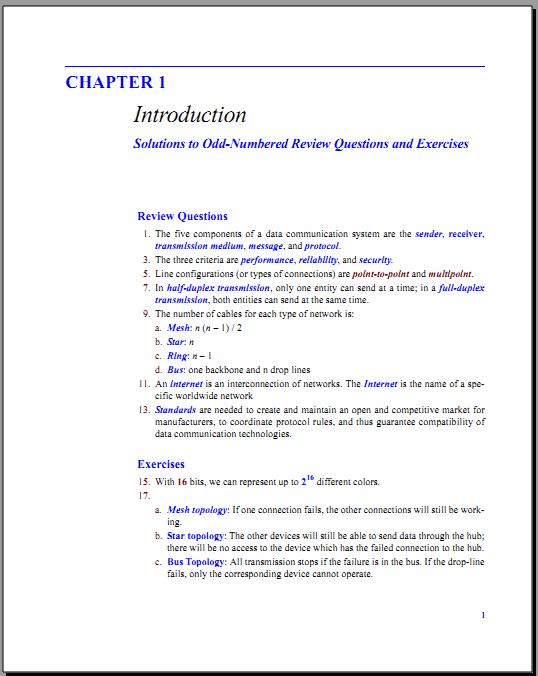
Solution Manual for Data Communications and Networking by Behrouz Forouzan

Solution Manual for Data Communications and Networking by Behrouz Forouzan

Download Here

Mediafire

Thursday, November 10, 2011

MODERN OPERATING SYSTEMS SECOND EDITION by Andrew S. Tanenbaum

MODERN OPERATING SYSTEMS SECOND EDITION by Andrew S. Tanenbaum


ABOUT THE AUTHOR


Andrew S. Tanenbaum has an S.B. degree from M.I.T. and a Ph.D. from the University of California at Berkeley. He is currently a Professor of Computer Science at the Vrije Universiteit in Amsterdam, The Netherlands, where he heads the Computer Systems Group. He is also Dean of the Advanced School for Com­puting and Imaging, an interuniversity graduate school doing research on advanced parallel, distributed, and imaging systems. Nevertheless, he is trying very hard to avoid turning into a bureaucrat.
In the past, he has done research on compilers, operating systems, networking, and local-area distributed systems. His current research focuses primarily on the design of wide-area distributed systems that scale to a billion users. These re­search projects have led to over 85 refereed papers in journals and conference proceedings and five books.
Prof. Tanenbaum has also produced a considerable volume of software. He was the principal architect of the Amsterdam Compiler Kit, a widely-used toolkit for writing portable compilers, as well as of MINIX, a small UNIX clone intended for use in student programming labs. Together with his Ph.D. students and pro­grammers, he helped design the Amoeba distributed operating system, a high-performance microkernel-based distributed operating system. The MINIX and Amoeba systems are now available for free via the Internet.
His Ph.D. students have gone on to greater glory after getting their degrees. He is very proud of them. In this respect he resembles a mother hen.
Prof. Tanenbaum is a Fellow of the ACM, a Fellow of the the IEEE, a member of the Royal Netherlands Academy of Arts and Sciences, winner of the 1994 ACM Karl V. Karlstrom Outstanding Educator Award, and winner of the 1997 ACM/SIGCSE Award for Outstanding Contributions to Computer Science Education. He is also listed in Who’s Who in the World. His home page on the World Wide Web can be found at URL http://www.cs.vu.nl/~ast/ .

Download Here

Mediafire

Let Us C Fifth Edition - Yashavant P. Kanetkar

Let Us C Fifth Edition - Yashavant P. Kanetkar 


About the Author
Destiny drew Yashavant Kanetkar towards computers when the IT
industry was just making a beginning in India. Having completed his education from VJTI Mumbai  and IIT Kanpur in Mechanical Engineering he started his training company in Nagpur. Yashavant has a passion for writing and is an author of several books in C, C++, VC++, C#, .NET, DirectX and COM programming. He is a much sought after speaker on various technology subjects and is a regular columnist for Express Computers and Developer 2.0. His current affiliations include being a Director of KICIT, a training company and DCube Software Technologies, a software development company. In recognition to his contribution Microsoft awarded him the prestigious  “Best .NET Technical Contributor” award recently. He can be reached at kanetkar@kicit.com.

Download Here

Mediafire

INSTRUCTOR’S MANUAL FOR ADVANCED ENGINEERING MATHEMATICS

INSTRUCTOR’S MANUAL FOR ADVANCED ENGINEERING MATHEMATICS

Download Here

Mediafire

Wednesday, November 9, 2011

Calculus 5th Edition Textbook - James Stewart

Calculus 5th Edition Textbook - James Stewart 


Download Here
Mediafire